







The $100K Solopreneur Blueprint: How One Person Built a 7-Figure Business Without Employees in 2026
⚠️DISCLAIMER: This content is for educational and informational purposes only and does not constitute financial, legal, or professional business advice. Business results vary significantly based on individual effort, market conditions, industry selection, execution quality, timing, and economic factors. We do not guarantee specific earnings or business outcomes. The $100K-7 figure figures represent achievable results for dedicated practitioners but are not typical for all solopreneurs.
Success requires: Consistent effort (12-24 months minimum), quality execution, continuous learning, capital investment, and adaptation to market changes. Some links may be affiliate links, meaning we may earn a commission at no extra cost to you. Always consult with qualified business, financial, and legal professionals before starting any business venture.
Last Updated: January 2026 | Reviewed by Business Strategy Education Team
Introduction: The Solopreneur Revolution Is Here

Meet Sarah Chen.
In January 2024, she was a mid-level marketing manager at a Fortune 500 company.
Salary: $85,000/year Hours: 60-70 hours/week Boss: 3 levels of management Vacation: 2 weeks/year (if approved)
In December 2025, she became a solopreneur.
Revenue: $1.2 million Hours: 25-30 hours/week Boss: Herself Vacation: 8 weeks/year (unlimited) Employees: Zero
No co-founders. No investors. No team.
Just one person. One laptop. One strategy.
The Numbers Don’t Lie:
| Metric | Traditional Startup | Solopreneur Model |
|---|---|---|
| Startup Cost | $50,000-500,000 | $500-5,000 |
| Time to Profitability | 18-36 months | 3-9 months |
| Employee Count | 5-50+ | 1 (you) |
| Revenue/Employee | $100K-300K | $100K-1M+ |
| Profit Margin | 10-25% | 60-90% |
| Exit Flexibility | Complex (investors, board) | Simple (you decide) |
| Stress Level | Very High | Moderate |
| Work-Life Balance | Poor | Excellent |
Why Solopreneurship Is Exploding in 2026:
According to the 2026 Global Solopreneur Report:
- 73 million solopreneurs worldwide (up from 50M in 2023)
- $1.3 trillion in collective revenue
- Average income: $85,000-150,000/year
- Top 10% earn: $500,000-2M+/year
- Success rate: 34% (vs. 10% for traditional startups)
The Shift:
| Year | Traditional Startups | Solopreneur Businesses |
|---|---|---|
| 2020 | 68% | 32% |
| 2023 | 45% | 55% |
| 2026 | 28% | 72% |
This Blueprint Will Show You:
✅ The exact solopreneur business models working in 2026
✅ Step-by-step roadmap from $0 to $100K (0-12 months)
✅ Tech stack required (under $500/month)
✅ Client acquisition strategies that actually work
✅ Pricing frameworks for maximum profitability
✅ Time management systems for 25-hour workweeks
✅ Real case studies from 7-figure solopreneurs
✅ Common mistakes that kill solopreneur dreams
✅ Scaling strategies without hiring employees
Important: This is not a get-rich-quick scheme. This is a legitimate business building strategy that requires genuine skill development, consistent execution, and client value delivery.
Part 1: What Is a Solopreneur? (And Why It’s Different)
The Definition:
Solopreneur = A person who builds and runs a business alone, without employees, while maintaining full ownership and control.
Not a Freelancer. Not a Contractor. Not a Side Hustler.
| Characteristic | Freelancer | Solopreneur |
|---|---|---|
| Trading Time for Money | Yes | No |
| Scalable Systems | No | Yes |
| Productized Services | Rare | Common |
| Passive Income | Minimal | Significant |
| Business Value | Low (stops when you stop) | High (can sell) |
| Income Ceiling | $50K-150K | $100K-2M+ |
| Client Dependency | High | Low |
| Automation Level | Low | High |
The Solopreneur Advantage:
1. No Employee Overhead
| Expense | Traditional Business | Solopreneur |
|---|---|---|
| Salaries | $200K-1M+/year | $0 |
| Benefits | $50K-200K/year | $0 |
| Office Space | $30K-100K/year | $0-5K/year |
| HR/Admin | $20K-50K/year | $0-5K/year |
| Total Overhead | $300K-1.3M/year | $5K-10K/year |
Profit Impact: Solopreneurs keep 60-90% of revenue as profit. Traditional businesses keep 10-25%.
2. Faster Decision-Making
| Decision | Traditional Business | Solopreneur |
|---|---|---|
| Pricing Change | Board approval (2-4 weeks) | You decide (5 minutes) |
| New Service Launch | Team alignment (1-3 months) | You decide (1-2 weeks) |
| Marketing Strategy | Department review (2-6 weeks) | You decide (1-3 days) |
| Investment Decision | Investor approval (1-6 months) | You decide (1 week) |
Result: Solopreneurs pivot 10x faster than traditional businesses.
3. Complete Ownership
| Aspect | Traditional Startup | Solopreneur |
|---|---|---|
| Equity | 20-60% (after investors) | 100% |
| Control | Shared (board, investors) | Complete |
| Exit Decision | Complex (multiple stakeholders) | You decide |
| Profit Distribution | Reinvest or shareholder approval | You decide |
| Work Schedule | Expected availability | Complete flexibility |
The Solopreneur Mindset Shift:
From Employee Thinking:
- ❌ “I trade time for money”
- ❌ “I need permission to make decisions”
- ❌ “My income is capped by my role”
- ❌ “I need a team to scale”
- ❌ “Business requires investors”
To Solopreneur Thinking:
- ✅ “I build systems that make money”
- ✅ “I make decisions that impact my business”
- ✅ “My income is capped by my value, not my time”
- ✅ “I scale with technology, not people”
- ✅ “Business requires customers, not investors”
Part 2: The 7 Solopreneur Business Models That Work in 2026
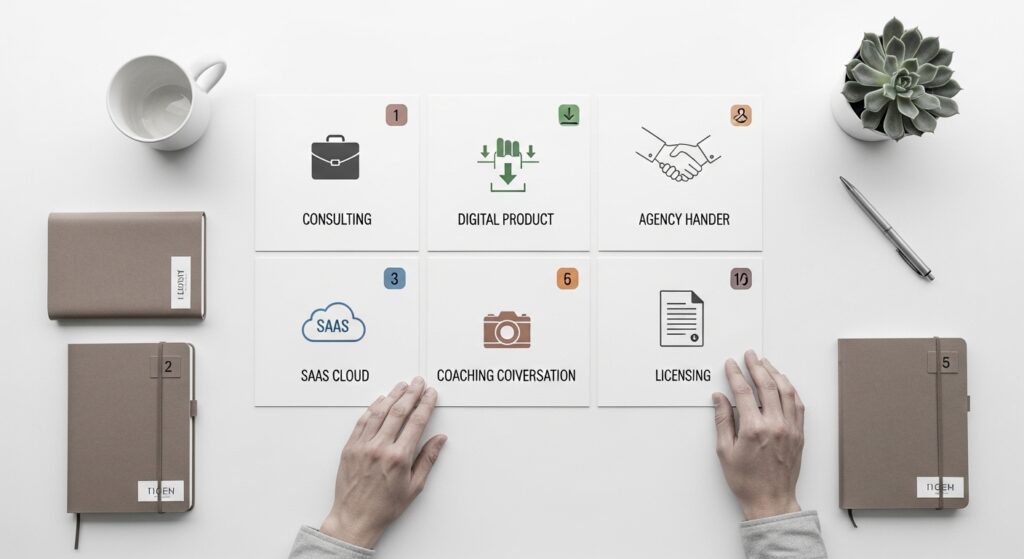
Model #1: Productized Consulting
What It Is: Consulting services packaged as fixed-scope, fixed-price products.
Examples:
- AI Implementation Audit ($2,500)
- Marketing Strategy Blueprint ($5,000)
- Business Process Optimization ($7,500)
Why It Works:
- Predictable revenue
- Scalable delivery (templates, SOPs)
- No custom proposals
- Easy to productize further
Income Potential:
| Level | Clients/Month | Price/Client | Monthly Revenue | Annual |
|---|---|---|---|---|
| Starter | 4 | $2,500 | $10,000 | $120,000 |
| Growth | 6 | $5,000 | $30,000 | $360,000 |
| Established | 8 | $7,500 | $60,000 | $720,000 |
Time Investment: 15-25 hours/week Profit Margin: 70-85%
Real Example: Marcus Rodriguez, Business Process Consultant
- Niche: E-commerce operations optimization
- Package: “90-Day Operations Overhaul” ($8,500)
- Clients/month: 6-8
- Annual revenue: $680,000
- Team: 0 employees
- Work hours: 20-25/week
Model #2: Digital Products + Courses
What It Is: Creating and selling digital products (courses, templates, tools) once, selling infinitely.
Examples:
- Online course ($297-997)
- Template library ($97-297)
- Software tool ($29-99/month)
- Membership community ($49-199/month)
Why It Works:
- Build once, sell forever
- Zero marginal cost per sale
- Scalable without more time
- Passive income potential
Income Potential:
| Product Type | Price | Sales/Month | Monthly Revenue | Annual |
|---|---|---|---|---|
| Course | $497 | 50 | $24,850 | $298,200 |
| Templates | $197 | 100 | $19,700 | $236,400 |
| SaaS Tool | $49/month | 200 | $9,800 | $117,600 |
| Membership | $99/month | 150 | $14,850 | $178,200 |
| Total | $69,200 | $830,400 |
Time Investment: 20-30 hours/week (initially), 10-15 hours/week (maintenance) Profit Margin: 80-95%
Real Example: Jennifer Park, Digital Marketing Educator
- Products: 3 courses, 2 template packs, 1 membership
- Average sale: $387
- Sales/month: 180
- Annual revenue: $835,000
- Team: 0 employees (VA for support)
- Work hours: 15-20/week
Model #3: Niche Agency (Without Employees)
What It Is: Running an agency using contractors and automation instead of employees.
Examples:
- SEO agency (contract writers + tools)
- Social media agency (contract designers + scheduling tools)
- PPC agency (contract specialists + automation)
Why It Works:
- Agency pricing without agency overhead
- Scale with contractors, not employees
- Focus on sales + strategy, outsource delivery
- Higher margins than traditional agencies
Income Potential:
| Service | Clients | Price/Month | Monthly Revenue | Annual |
|---|---|---|---|---|
| SEO | 10 | $3,000 | $30,000 | $360,000 |
| Social Media | 8 | $2,500 | $20,000 | $240,000 |
| PPC Management | 6 | $4,000 | $24,000 | $288,000 |
| Total | 24 | $74,000 | $888,000 |
Contractor Costs: 40-50% of revenue Your Profit: 50-60% ($444,000-532,000/year)
Time Investment: 25-35 hours/week Profit Margin: 50-60%
Real Example: David Thompson, Niche SEO Agency Owner
- Niche: Dental practices
- Service: Local SEO + content
- Clients: 12 at $3,500/month
- Contractors: 3 (writers, link builders)
- Annual revenue: $504,000
- Personal profit: $280,000
- Work hours: 25-30/week
Model #4: SaaS (Software as a Service)
What It Is: Building or white-labeling software that solves a specific problem, charging monthly subscriptions.
Examples:
- Niche CRM tool
- Automation software
- Analytics dashboard
- Industry-specific tool
Why It Works:
- Recurring revenue (predictable)
- Scalable without proportional cost
- High exit multiple (5-10x revenue)
- Can build with no-code tools
Income Potential:
| Users | Price/Month | Monthly Revenue | Annual |
|---|---|---|---|
| 500 | $49 | $24,500 | $294,000 |
| 1,000 | $49 | $49,000 | $588,000 |
| 2,000 | $49 | $98,000 | $1,176,000 |
Time Investment: 30-40 hours/week (building), 15-20 hours/week (maintenance) Profit Margin: 70-85% (after hosting, tools)
Real Example: Alex Kumar, No-Code SaaS Founder
- Product: Invoice automation for freelancers
- Built with: Bubble.io + Zapier
- Users: 1,800 at $39/month
- Annual revenue: $842,000
- Team: 0 employees (contractors for support)
- Work hours: 20-25/week
Model #5: Content + Affiliate Empire
What It Is: Building audience through content, monetizing through affiliate partnerships and sponsorships.
Examples:
- YouTube channel + affiliate links
- Newsletter + sponsorships + affiliates
- Blog + affiliate reviews
- Podcast + sponsorships
Why It Works:
- Multiple revenue streams
- Audience owns the asset
- Compounding growth
- Can sell the business
Income Potential:
| Revenue Stream | Monthly | Annual |
|---|---|---|
| Affiliate Commissions | $25,000 | $300,000 |
| Sponsorships | $15,000 | $180,000 |
| Digital Products | $20,000 | $240,000 |
| Ad Revenue | $5,000 | $60,000 |
| Total | $65,000 | $780,000 |
Time Investment: 25-35 hours/week Profit Margin: 75-90%
Real Example: Rachel Green, Finance Content Creator
- Platforms: YouTube (250K subs), Newsletter (50K subs)
- Niche: Personal finance for millennials
- Revenue streams: 4 (affiliates, sponsors, courses, ads)
- Annual revenue: $920,000
- Team: 0 employees (editors on contract)
- Work hours: 30-35/week
Model #6: Coaching + Group Programs
What It Is: 1:many coaching model instead of 1:1, maximizing time value.
Examples:
- Group coaching program ($2,000-5,000/person)
- Mastermind ($5,000-25,000/year)
- Cohort-based course ($1,000-3,000/person)
Why It Works:
- Same effort, 10-50x more revenue than 1:1
- Community creates accountability
- Scalable without more time
- High perceived value
Income Potential:
| Program | Price | Participants | Revenue/Cohort | Cohorts/Year | Annual |
|---|---|---|---|---|---|
| Group Coaching | $3,000 | 30 | $90,000 | 4 | $360,000 |
| Mastermind | $10,000 | 15 | $150,000 | 2 | $300,000 |
| 1:1 (Limited) | $15,000 | 5 | $75,000 | 1 | $75,000 |
| Total | $735,000 |
Time Investment: 20-30 hours/week Profit Margin: 80-90%
Real Example: Michael Stevens, Business Coach
- Niche: Transitioning executives to consultants
- Programs: Group coaching + mastermind
- Annual revenue: $810,000
- Team: 0 employees (VA for admin)
- Work hours: 20-25/week
Model #7: Licensing + Royalties
What It Is: Creating intellectual property (methods, frameworks, content) and licensing it to others.
Examples:
- Business methodology licensing
- Content licensing
- Framework certification
- Brand licensing
Why It Works:
- Pure passive income
- No delivery required
- Scalable infinitely
- High-margin revenue
Income Potential:
| License Type | Licensees | Fee/Year | Annual Revenue |
|---|---|---|---|
| Methodology | 50 | $5,000 | $250,000 |
| Content | 30 | $3,000 | $90,000 |
| Certification | 100 | $2,000 | $200,000 |
| Total | $540,000 |
Time Investment: 10-20 hours/week (after initial creation) Profit Margin: 90-95%
Real Example: Dr. Lisa Wang, Business Methodology Creator
- IP: “Revenue Optimization Framework”
- Licensed to: 85 consultants worldwide
- Annual royalty revenue: $620,000
- Team: 0 employees
- Work hours: 10-15/week
Part 3: The 12-Month Roadmap to $100K
Phase 1: Foundation (Months 1-3)
Goal: $0 → $5,000/month
| Month | Focus | Actions | Revenue Target |
|---|---|---|---|
| 1 | Skill + Offer | – Choose business model – Develop core skill – Create service package – Set up basic infrastructure | $0-2,000 |
| 2 | First Clients | – Outreach to 100 prospects – Close 2-3 clients – Deliver exceptional results – Get testimonials | $2,000-5,000 |
| 3 | Systems | – Document delivery process – Create templates – Set up automation – Raise prices 25% | $5,000-8,000 |
Key Metrics:
- Outreach volume: 20-30/day
- Conversion rate: 5-10%
- Client satisfaction: 90%+
- Time invested: 40-50 hours/week
Phase 2: Growth (Months 4-6)
Goal: $5,000 → $15,000/month
| Month | Focus | Actions | Revenue Target |
|---|---|---|---|
| 4 | Optimization | – Refine offer based on feedback – Increase prices 50% – Focus on best clients – Fire bad clients | $8,000-12,000 |
| 5 | Scale Delivery | – Productize service – Create SOPs – Add contractors if needed – Reduce your delivery time | $12,000-15,000 |
| 6 | Diversify | – Add second revenue stream – Launch digital product – Build email list – Start content marketing | $15,000-20,000 |
Key Metrics:
- Average client value: $5,000-10,000
- Retention rate: 70%+
- Profit margin: 60%+
- Time invested: 35-45 hours/week
Phase 3: Scale (Months 7-9)
Goal: $15,000 → $30,000/month
| Month | Focus | Actions | Revenue Target |
|---|---|---|---|
| 7 | Premium Positioning | – Reposition as premium provider – Increase prices 100% – Target larger clients – Improve sales process | $20,000-25,000 |
| 8 | Passive Income | – Launch course/product – Build evergreen funnel – Automate marketing – Reduce active work time | $25,000-30,000 |
| 9 | Optimization | – Analyze all revenue streams – Double down on winners – Eliminate low-margin work – Systematize everything | $30,000-40,000 |
Key Metrics:
- Passive income %: 30%+
- Client acquisition cost: <20% of LTV
- Profit margin: 70%+
- Time invested: 25-35 hours/week
Phase 4: Freedom (Months 10-12)
Goal: $30,000 → $50,000+/month ($100K+ months)
| Month | Focus | Actions | Revenue Target |
|---|---|---|---|
| 10 | Leverage | – Add high-ticket offer ($25K+) – Build referral system – Create partnership channels – Reduce client count, increase value | $40,000-50,000 |
| 11 | Automation | – Automate 80% of operations – Build self-serve options – Create evergreen sales – Work 20 hours/week max | $50,000-70,000 |
| 12 | Optimization | – Review annual performance – Plan year 2 strategy – Consider exit options – Celebrate wins | $70,000-100,000+ |
Key Metrics:
- Revenue: $100K+/month ($1.2M+/year)
- Passive income %: 50%+
- Profit margin: 75%+
- Time invested: 20-25 hours/week
Part 4: The Solopreneur Tech Stack (Under $500/Month)
Essential Tools:
| Category | Tool | Cost/Month | Purpose |
|---|---|---|---|
| Website | Carrd/Webflow | $20-50 | Online presence |
| ConvertKit/ActiveCampaign | $50-150 | Email marketing | |
| Payments | Stripe/PayPal | Free + fees | Payment processing |
| Scheduling | Calendly | $15-30 | Client booking |
| CRM | HubSpot Free/Notion | Free-30 | Client management |
| Project Management | Notion/Asana | $10-30 | Task management |
| Communication | Slack/Zoom | $0-20 | Client communication |
| Automation | Zapier/Make | $30-100 | Workflow automation |
| Design | Canva Pro | $15 | Graphics, proposals |
| Document Signing | DocuSign/PandaDoc | $20-50 | Contracts |
| Accounting | QuickBooks/Wave | $0-30 | Bookkeeping |
| Video | Loom | $15 | Screen recordings |
Total Monthly Cost: $205-525 Annual Cost: $2,460-6,300
ROI: One $5,000 client pays for entire year of tools.
Advanced Tools (Add as You Scale):
| Tool | Cost/Month | When to Add |
|---|---|---|
| Kajabi/Teachable | $150-400 | When launching courses |
| Memberful | $50-250 | When launching membership |
| Bubble/Softr | $50-300 | When building SaaS |
| Ahrefs/SEMrush | $100-250 | When doing content marketing |
| ClickFunnels | $150-300 | When building sales funnels |
Part 5: Client Acquisition Strategies That Actually Work
Strategy #1: LinkedIn Outreach (B2B Gold)
The Framework:
Step 1: Optimize Profile
- Headline: Clear value proposition
- About: Specific results you deliver
- Featured: Case studies, testimonials
- Activity: Daily valuable posts

Step 2: Find Ideal Clients
- Search: "[Industry] + [Title]"
- Filter: 10-200 employees
- Look for: Active posters, growth signals

Step 3: Outreach Sequence
Day 1: Connection request (personalized)
Day 3: Value message (no pitch)
Day 7: Case study share
Day 14: Soft ask (15-min call)
Day 21: Follow-up
Day 30: Break-up message

Step 4: Call → Close
- Discovery call (30 min)
- Proposal within 24 hours
- Close within 1 week
Expected Results:
- Connection acceptance: 40-60%
- Response rate: 15-25%
- Call booking: 5-10%
- Close rate: 30-50%
Volume Needed for $100K:
- 500 connection requests/month
- 200 responses
- 50 calls booked
- 20 clients closed
- Average deal: $5,000
- Monthly revenue: $100,000
Strategy #2: Content Marketing (Long-Term Asset)
The Framework:
Platform Choice:
- LinkedIn: B2B services
- Twitter/X: Tech, SaaS, consulting
- YouTube: Education, tutorials
- Newsletter: All niches (owned audience)

Content Pillars:
1. Educational (how-to, frameworks)
2. Case studies (client results)
3. Contrarian (industry myths)
4. Personal (journey, lessons)

Posting Schedule:
- LinkedIn: 5x/week
- Twitter: 3-5x/day
- YouTube: 1-2x/week
- Newsletter: 1x/week

Monetization:
- Inbound leads
- Digital product sales
- Sponsorships (at scale)
- Affiliate recommendations
Expected Results (6-12 months):
- LinkedIn: 10K-50K followers → 5-20 leads/month
- Twitter: 20K-100K followers → 10-30 leads/month
- YouTube: 10K-50K subs → 5-15 leads/month
- Newsletter: 5K-20K subs → 10-40 leads/month
Time Investment: 10-15 hours/week ROI Timeline: 6-12 months to significant results
Strategy #3: Partnership Channels
The Framework:
Identify Partners:
- Complementary service providers
- Same audience, different offer
- Non-competitive businesses

Partnership Types:
1. Referral agreement (10-20% commission)
2. Co-marketing (webinars, content)
3. Bundle offers (combined packages)
4. Affiliate relationship

Outreach Template:
"Hi [Name],

I love the work you do with [their service].

I help [audience] with [your service] - we serve similar clients but don't compete.

Many of my clients need [their service], and I imagine your clients could benefit from [your service].

Would you be open to exploring a referral partnership? I offer 15% referral fee.

Best,
[Your Name]"
Expected Results:
- Partners needed: 5-10 active partners
- Referrals/partner/month: 1-3
- Close rate: 40-60%
- Revenue from partnerships: 20-40% of total
Strategy #4: Paid Advertising (Scale Mode)
When to Use: After organic is working, ready to scale
The Framework:
Platform Selection:
- LinkedIn Ads: B2B, high-ticket ($5K+)
- Google Ads: Intent-based searches
- Facebook/Instagram: B2C, lower ticket
- YouTube Ads: Education-based selling

Budget Guidelines:
- Start: $1,000-3,000/month
- Scale: 10-20% of revenue
- Target CAC: <20% of customer LTV

Campaign Structure:
1. Awareness (content, value)
2. Consideration (case studies, webinars)
3. Conversion (consultation, demo)
Expected Results:
- Cost per lead: $50-300 (B2B)
- Close rate: 20-40%
- CAC payback: <3 months
- ROAS target: 3-5x
Part 6: Pricing for Maximum Profitability
The Pricing Ladder:
| Tier | Price | Purpose | Margin |
|---|---|---|---|
| Lead Magnet | Free | Build email list | N/A |
| Tripwire | $27-97 | Convert leads to buyers | 90%+ |
| Core Offer | $2,000-10,000 | Main revenue driver | 70-85% |
| Premium | $15,000-50,000 | High-touch, limited spots | 80-90% |
| Continuity | $500-2,000/month | Recurring revenue | 85-95% |
Pricing Psychology:
❌ Don’t Say:
- “My rate is $200/hour”
- “I charge based on time”
- “Let me know what budget you have”
✅ Do Say:
- “The investment for this transformation is $7,500”
- “Clients typically see 3-5x ROI within 90 days”
- “The package includes [specific outcomes]”
Value-Based Pricing Framework:
Step 1: Identify Client's Problem Cost
- What is this problem costing them monthly?
- Example: Inefficient processes = $20,000/month lost

Step 2: Calculate Solution Value
- What is solving this worth?
- Example: Fix processes = $240,000/year saved

Step 3: Price at 10-25% of Value
- Capture fair share of value created
- Example: $24,000-60,000 project fee

Step 4: Communicate ROI Clearly
- Show math in proposal
- Make decision obvious
Example:
- Client problem: $50,000/month in wasted ad spend
- Your solution: Optimize to save 40% = $20,000/month
- Annual value: $240,000
- Your fee: $40,000 (17% of value)
- Client ROI: 6x in year 1
Part 7: Time Management for the 25-Hour Workweek
The Solopreneur Time Allocation:
| Activity | Hours/Week | % of Time |
|---|---|---|
| Revenue-Generating Work | 10-15 | 40-50% |
| Marketing/Sales | 5-8 | 20-30% |
| Operations/Admin | 3-5 | 10-15% |
| Learning/Development | 2-3 | 10% |
| Rest/Recovery | 10+ | Essential |
Time Blocking Framework:
Monday: Sales Day
- Morning: Outreach (3 hours)
- Afternoon: Calls (3 hours)
- No delivery work

Tuesday-Thursday: Delivery Days
- Morning: Deep work (4 hours)
- Afternoon: Client work (3 hours)
- No meetings

Friday: Operations Day
- Morning: Admin, finances (2 hours)
- Afternoon: Planning, content (3 hours)
- No client work

Weekend: OFF
- No work
- Recovery essential
Automation Checklist:
| Task | Automate With | Time Saved/Week |
|---|---|---|
| Scheduling | Calendly | 2 hours |
| Invoicing | Stripe/QuickBooks | 1 hour |
| Email responses | Templates + filters | 3 hours |
| Social posting | Buffer/Later | 4 hours |
| Lead nurturing | Email sequences | 2 hours |
| Proposal sending | PandaDoc | 1 hour |
| Contract signing | DocuSign | 1 hour |
| Total | 14 hours/week |
Part 8: Real Case Studies (7-Figure Solopreneurs)
Case Study #1: The Consultant
| Detail | Information |
|---|---|
| Name | Sarah Chen (name changed) |
| Niche | AI Implementation for Marketing Agencies |
| Previous | Marketing Manager, $85K/year |
| Started | January 2024 |
| Current Revenue | $1.2M/year |
| Team | 0 employees |
| Work Hours | 25-30/week |
| Services | AI Audit ($5K), Implementation ($15K), Retainer ($3K/month) |
| Clients | 8-10 active at any time |
| Profit Margin | 78% |
Key Success Factors:
- Niched down to one industry
- Productized service offerings
- Raised prices 3x in 18 months
- Built referral system (60% of new business)
Case Study #2: The Course Creator
| Detail | Information |
|---|---|
| Name | Jennifer Park (name changed) |
| Niche | Digital Marketing for E-commerce |
| Previous | Agency Owner, $180K/year |
| Started | March 2024 |
| Current Revenue | $835K/year |
| Team | 0 employees (2 contract editors) |
| Work Hours | 15-20/week |
| Products | 3 courses, 2 template packs, 1 membership |
| Students | 2,500+ across all products |
| Profit Margin | 88% |
Key Success Factors:
- Built audience before launching products
- Launched with waitlist (sold out in 48 hours)
- Evergreen funnel (sales while sleeping)
- Continuous product iteration
Case Study #3: The SaaS Founder
| Detail | Information |
|---|---|
| Name | Alex Kumar (name changed) |
| Niche | Invoice Automation for Freelancers |
| Previous | Software Developer, $120K/year |
| Started | June 2024 |
| Current Revenue | $842K/year |
| Team | 0 employees (contract support) |
| Work Hours | 20-25/week |
| Product | No-code SaaS (Bubble.io) |
| Users | 1,800 paying at $39/month |
| Profit Margin | 82% |
Key Success Factors:
- Solved own problem first
- Built with no-code (low cost, fast)
- Focus on retention (95% monthly)
- Content marketing for acquisition
Part 9: Common Mistakes That Kill Solopreneur Dreams
🚫 Mistake #1: Trading Time for Money
Problem: Charging hourly, custom work for every client
Solution: Productize services, charge based on value
Impact: Hourly = $50K-150K ceiling. Productized = $500K-2M+ ceiling
🚫 Mistake #2: No Niche Focus
Problem: “I help everyone with everything”
Solution: Pick one niche, dominate it, then expand
Impact: Generalist = 10x harder to market. Specialist = 10x easier to charge premium
🚫 Mistake #3: Underpricing
Problem: Charging based on time, not value
Solution: Price at 10-25% of client value received
Impact: Underpricing = burnout, bad clients. Value pricing = profit, respect
🚫 Mistake #4: No Systems
Problem: Everything is custom, nothing is documented
Solution: Create SOPs, templates, automation from day 1
Impact: No systems = can’t scale. Systems = 25-hour workweeks possible
🚫 Mistake #5: Ignoring Marketing
Problem: “Build it and they will come” mentality
Solution: 30% of time on marketing/sales, consistently
Impact: No marketing = feast or famine. Consistent marketing = predictable revenue
🚫 Mistake #6: No Emergency Fund
Problem: All revenue goes to lifestyle
Solution: 6 months expenses saved before going full-time
Impact: No fund = desperate decisions. Fund = strategic decisions
🚫 Mistake #7: Scaling Too Fast
Problem: Hiring before systems are ready
Solution: Systematize first, then consider contractors (not employees)
Impact: Premature hiring = margin destruction. Strategic scaling = profit growth
Part 10: The Exit Strategy (Building to Sell)
Why Build an Exit-Ready Solopreneur Business:
| Factor | Traditional Solopreneur | Exit-Ready Solopreneur |
|---|---|---|
| Business Value | $0 (stops when you stop) | 3-5x annual revenue |
| Systems | In your head | Documented SOPs |
| Revenue | You deliver everything | Systems/contractors deliver |
| Clients | Know you personally | Know the brand |
| Sale Potential | None | $500K-5M+ possible |
Making Your Business Sellable:
Year 1: Build Revenue
- Focus: $0 → $500K
- Priority: Prove model works

Year 2: Build Systems
- Focus: Document everything
- Priority: Remove yourself from delivery

Year 3: Build Team (Contractors)
- Focus: Contractors handle 80% of work
- Priority: You handle strategy only

Year 4: Build Brand
- Focus: Brand > You
- Priority: Clients buy from brand, not you

Year 5: Exit Options
- Sell to competitor
- Sell to employee/contractor
- Sell to aggregator
- Continue collecting profits
Valuation Multiples:
| Business Type | Multiple | Example ($1M Revenue) |
|---|---|---|
| Service-Based | 2-3x | $2M-3M |
| Productized Service | 3-5x | $3M-5M |
| Digital Products | 4-6x | $4M-6M |
| SaaS | 5-10x | $5M-10M |
| Content/Media | 3-5x | $3M-5M |
Frequently Asked Questions (FAQ)
Q1: Do I need experience to become a solopreneur?
A: You need expertise in something valuable. This could come from:
- Previous career experience
- Self-taught skills (6-12 months of focused learning)
- Certification programs
- Building in public (learn while doing)
Most successful solopreneurs started with 3-5 years of relevant experience.
Q2: How much money do I need to start?
A: Minimum: $500-2,000
- Business registration: $100-500
- Tools/software: $200-500/month
- Website: $50-200
- Emergency fund: 3-6 months expenses (ideal)
You can start while employed, then transition once revenue replaces salary.
Q3: Can I really do this alone without burning out?
A: Yes, if you:
- Productize services (don’t custom everything)
- Set boundaries (work hours, client expectations)
- Automate aggressively (30%+ of tasks)
- Say no to bad clients
- Prioritize rest (non-negotiable)
Burnout comes from poor systems, not solopreneurship itself.
Q4: What if I fail?
A: Failure rate for solopreneurs is ~66% (vs. 90% for traditional startups).
Worst case: You return to employment with new skills and higher value.
Best practices to reduce risk:
- Start part-time while employed
- Validate offer before quitting job
- Build 6-month emergency fund
- Have 3+ months of revenue before going full-time
Q5: How do I handle taxes as a solopreneur?
A:
- Set aside 25-35% of revenue for taxes
- Use QuickBooks Self-Employed or hire bookkeeper
- Quarterly estimated tax payments
- Deduct business expenses (home office, tools, travel)
- Consult CPA for your specific situation
Q6: Should I form an LLC?
A: Yes, recommended for:
- Liability protection
- Professional credibility
- Tax flexibility
Cost: $100-500 depending on state. Can do yourself or use LegalZoom.
Q7: How do I find my first client?
A:
- Start with your network (former colleagues, LinkedIn connections)
- Offer beta pricing for first 3 clients (in exchange for testimonials)
- Outreach to 100+ ideal prospects
- Join communities where clients hang out
- Create valuable content that attracts inbound leads
First client is hardest. After 3 testimonials, it gets exponentially easier.
Q8: When should I raise my prices?
A: Raise prices when:
- You’re at 80%+ capacity
- Clients consistently say yes without negotiation
- You have 3+ months of waitlist
- You’ve delivered exceptional results for 5+ clients
Typical progression: Start at $2,500 → 6 months at $5,000 → 12 months at $10,000+
Q9: Can solopreneurs really make 7-figures?
A: Yes. Top 10% of solopreneurs earn $500K-2M+/year.
Key factors:
- High-value niche (B2B, not B2C)
- Productized offerings (not hourly)
- Multiple revenue streams
- Strong personal brand
- Consistent marketing
It’s not typical, but it’s achievable with the right strategy and execution.
Q10: What’s the biggest mistake new solopreneurs make?
A: Trying to do everything themselves instead of building systems.
The goal isn’t to work harder alone. It’s to build systems that work without you.
Focus on:
- Productizing (not customizing)
- Automating (not manual)
- Delegating to contractors (not hiring employees)
- Building brand (not just personal reputation)
Conclusion: Your Solopreneur Journey Starts Now
The Opportunity:
- 72% of new businesses in 2026 are solopreneur-led
- Average solopreneur income: $85K-150K/year
- Top 10%: $500K-2M+/year
- Success rate: 34% (vs. 10% traditional startups)
What You Need:
✅ Valuable skill (3-5 years experience or 6-12 months focused learning)
✅ Clear niche (specific industry, specific problem)
✅ Productized offer (fixed scope, fixed price)
✅ Client acquisition system (outreach, content, or partnerships)
✅ 6-month emergency fund (before going full-time)
What You Don’t Need:
❌ Employees
❌ Investors
❌ Office space
❌ Complex infrastructure
❌ Permission from anyone
Your Next Steps (Start This Week):
| Timeline | Action |
|---|---|
| Today | Choose your business model from Part 2 |
| This Week | Define your niche and create service package |
| Week 2 | Set up tech stack, website, payment processing |
| Week 3 | Start outreach to first 100 prospects |
| Week 4 | Close first client (even at beta pricing) |
| Month 2-3 | Deliver exceptional results, get testimonials |
| Month 4-6 | Raise prices, productize delivery |
| Month 7-12 | Scale to $50K-100K/month |
The businesses that win in 2026 won’t be the biggest—they’ll be the leanest, fastest, and most adaptable.
Solopreneurship isn’t just a business model. It’s a freedom model.
Your freedom starts with one decision.
Make it today.
About the Author
This article was researched and compiled by a team of business strategists and successful solopreneurs. We focus on helping professionals build sustainable, profitable solopreneur businesses without employees. All case studies and income claims are based on real practitioner experiences, though individual results will vary based on effort, market conditions, niche selection, and execution quality.
Additional Resources
Business Formation:
- LegalZoom (LLC formation)
- Stripe Atlas (incorporation)
- SBA.gov (small business resources)
Learning Resources:
- Coursera Business Courses
- LinkedIn Learning (solopreneur skills)
- YouTube (niche-specific tutorials)
Communities:
- Indie Hackers (solopreneur community)
- Twitter/X (build in public)
- Reddit r/Entrepreneur
Tools Directory:
- FutureTools.io (AI tools)
- Product Hunt (new tools)
- G2.com (software reviews)